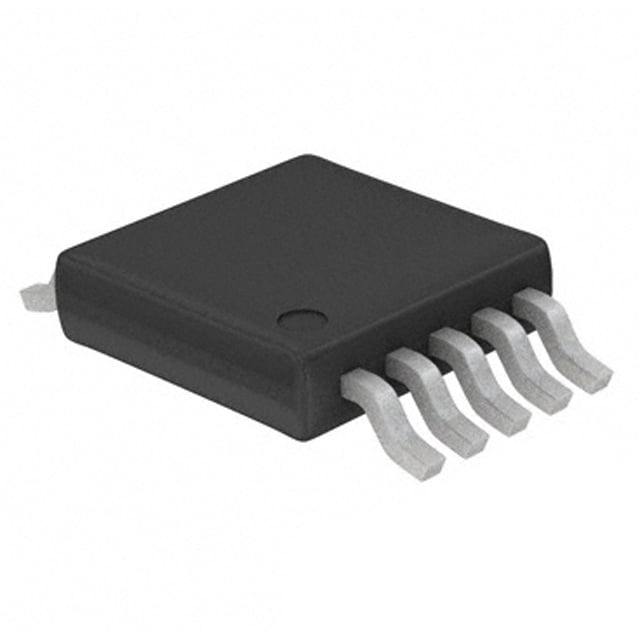
Q1: What is the Cirrus Logic CS2000CP-DZZ?
A1: The Cirrus Logic CS2000CP-DZZ is a high-performance clock synthesizer and jitter attenuator designed to generate low-jitter clock signals for demanding digital audio, video, and communication systems, ensuring precise timing and synchronization.
Q2: What applications is the CS2000CP-DZZ suited for?
A2: This device is ideal for applications in digital audio interfaces, professional audio equipment, telecommunications infrastructure, broadcast systems, and any system requiring stable, low-jitter clock sources.
Q3: What input clock frequencies does the CS2000CP-DZZ support?
A3: The CS2000CP-DZZ supports a wide range of input clock frequencies, allowing flexibility to interface with various reference clocks commonly used in audio and communication systems.
Q4: How does the CS2000CP-DZZ reduce jitter?
A4: It incorporates advanced phase-locked loop (PLL) and loop filter designs to effectively clean up incoming clock signals and generate ultra-low jitter output clocks critical for maintaining signal integrity.
Q5: What output clock capabilities does the Cirrus Logic CS2000CP-DZZ provide?
A5: The device can generate multiple output clocks with programmable frequencies and phases, supporting diverse system timing requirements with high precision.
Q6: What communication interface is used for programming the CS2000CP-DZZ?
A6: The CS2000CP-DZZ is programmable via an industry-standard I²C interface, enabling flexible and easy configuration of its operating parameters.
Q7: What is the power supply requirement for the CS2000CP-DZZ?
A7: It operates on a standard 3.3V power supply, making it compatible with modern digital systems while minimizing power consumption.
Q8: How does the CS2000CP-DZZ ensure phase noise performance?
A8: By utilizing proprietary PLL architectures and low-noise voltage-controlled oscillators (VCOs), the device achieves exceptionally low phase noise, which is essential for high-fidelity clock generation.
Q9: What package does the CS2000CP-DZZ come in?
A9: It is offered in a compact 20-pin TSSOP package, facilitating easy PCB layout and integration in space-constrained designs.
Q10: Can the CS2000CP-DZZ handle multiple output clock domains?
A10: Yes, the device supports multiple output clocks with independent frequency and phase control, allowing synchronization of different system components.
Q11: What temperature range is supported by the Cirrus Logic CS2000CP-DZZ?
A11: It operates reliably over the industrial temperature range from -40°C to +85°C, making it suitable for various environmental conditions.
Q12: How fast is the CS2000CP-DZZ’s locking time?
A12: The synthesizer has a fast lock time, allowing quick synchronization of output clocks after power-up or frequency changes, which is critical in dynamic systems.
Q13: What jitter performance can be expected from the CS2000CP-DZZ?
A13: The device typically provides jitter performance in the low picosecond range, significantly improving system timing accuracy compared to standard oscillators.
Q14: Does the CS2000CP-DZZ support spread-spectrum clocking?
A14: While its primary function is jitter attenuation and synthesis, the device includes features to minimize electromagnetic interference, but spread-spectrum clocking is not its main function.
Q15: What is the typical application of the CS2000CP-DZZ in audio systems?
A15: In professional audio systems, the CS2000CP-DZZ ensures synchronized sampling clocks for DACs and ADCs, reducing artifacts and improving audio quality.
Q16: How does the CS2000CP-DZZ contribute to system stability?
A16: By providing clean, stable clock signals with low jitter and phase noise, it prevents timing-related errors and data corruption in complex digital systems.
Q17: What is the programming flexibility of the CS2000CP-DZZ?
A17: Its I²C interface and extensive register map allow customization of output frequencies, phase adjustments, and loop filter parameters to tailor performance to specific application needs.
Q18: Can the CS2000CP-DZZ replace traditional crystal oscillators?
A18: Yes, due to its programmability and low jitter, the CS2000CP-DZZ can serve as a more versatile and precise alternative to fixed-frequency crystal oscillators.
Q19: What makes the CS2000CP-DZZ suitable for telecommunications?
A19: The device’s low phase noise and jitter performance enable high-speed data transmission and synchronization essential in telecom equipment such as base stations and routers.
Q20: How does the CS2000CP-DZZ integrate with system clock architectures?
A20: It can act as a central timing source or a jitter-cleaning element within complex clock distribution networks, enhancing overall system clock integrity and performance.