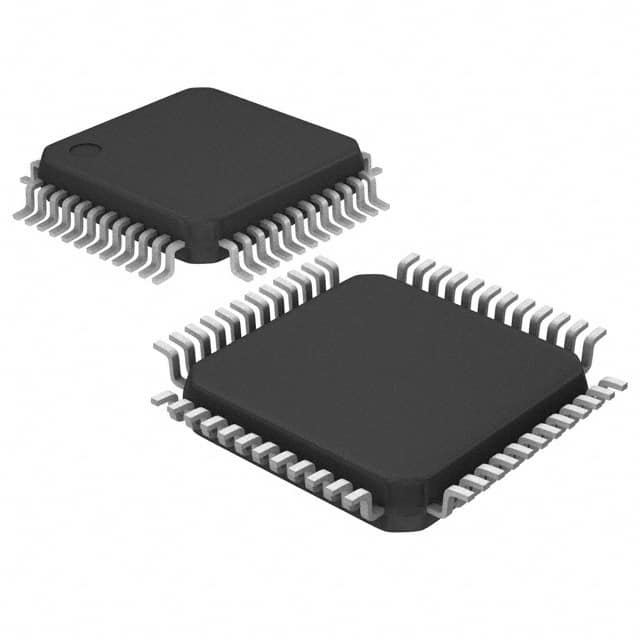
The SC16C852SVIET,115 is a dual universal asynchronous receiver/transmitter (UART) device designed to extend serial communication capability in embedded and industrial systems where host processors have limited native UART resources. It integrates two independent UART channels with on-chip buffering, providing a bridge between a parallel or serial host interface and asynchronous serial links. The device is positioned for applications requiring robust serial data handling, deterministic interrupt behavior, and flexible host interface integration via serial bus protocols. Its architecture is optimized for reliable full-duplex communication with reduced host intervention through internal FIFO buffering and interrupt-driven operation.
## Functional Architecture and Device Positioning
The SC16C852 family implements a dual-channel UART subsystem within a single integrated circuit. Each channel operates independently and supports full-duplex asynchronous serial communication, including separate transmit and receive paths. The internal architecture includes transmit and receive FIFOs per channel, allowing temporary storage of data to decouple host access timing from serial line activity. This buffering mechanism reduces the frequency of host processor interrupts and improves overall system efficiency in interrupt-driven or DMA-assisted designs.
The device is designed to interface with modern embedded controllers through a serial host interface, typically I2C or SPI depending on configuration variant. This architecture eliminates the need for a parallel bus interface commonly found in legacy UART expansions, enabling compact PCB design and simplified routing. The internal register set is accessed through the host interface and provides control over UART configuration, status monitoring, FIFO management, and interrupt behavior.
## Core UART Functionality and Internal Features
Each UART channel provides standard asynchronous serial communication capabilities, including configurable word length, parity generation and checking, and stop-bit configuration. The transmitter and receiver blocks are fully independent, allowing simultaneous bidirectional communication. The inclusion of FIFO buffers on both transmit and receive paths significantly reduces the risk of data overrun and underrun conditions under high-throughput or interrupt-latency-constrained environments.
A programmable baud rate generator is integrated into the device, allowing flexible serial data rate configuration derived from the internal clock input. The UART logic supports standard framing detection, break detection, and error reporting mechanisms such as framing error, parity error, and overrun error conditions. These error flags are accessible via status registers through the host interface and can be configured to trigger interrupt events.
Interrupt generation is highly configurable and can be asserted based on multiple internal events, including receive FIFO thresholds, transmit FIFO empty conditions, line status changes, and modem status transitions. This event-driven architecture enables efficient system-level integration with minimal polling overhead.
## Host Interface and Register Architecture
The SC16C852SVIET,115 communicates with the host processor through a serial interface controller that abstracts internal UART register access. Depending on system configuration, the device supports industry-standard serial control protocols, enabling compatibility with a wide range of microcontrollers, processors, and FPGA-based systems.
The internal register map is organized into functional blocks covering UART configuration, FIFO control, interrupt enable and status registers, line status monitoring, and modem control logic. The register architecture is designed to support both initialization-phase configuration and runtime monitoring without requiring complex external logic. FIFO control registers provide mechanisms for resetting buffers and defining trigger behavior for interrupt generation.
The device supports hardware flow control signals to ensure reliable data transfer under high-throughput conditions. These signals can be used to coordinate data flow between the UART and external transceivers, preventing buffer overflow in downstream systems.
## Electrical Characteristics and Integration Considerations
The SC16C852SVIET,115 is designed for operation within industrial and embedded voltage domains and includes level compatibility suitable for direct interfacing with modern low-voltage logic systems. It is implemented in a CMOS process optimized for low power consumption and stable operation across extended temperature ranges typical of industrial environments.
Signal integrity considerations are addressed through controlled output drive characteristics and defined input thresholds compatible with standard logic families. The device includes internal reset logic to ensure deterministic startup behavior, with all registers initialized to defined states upon power-up or hardware reset assertion.
Electromagnetic robustness is supported through standard integrated circuit design practices, including on-chip decoupling structures and input protection circuitry. These characteristics allow the device to be used in electrically noisy environments such as industrial automation systems, communication gateways, and embedded control modules.
## Package and Mechanical Implementation
The SC16C852SVIET,115 is supplied in a surface-mount package suitable for high-density PCB designs. The package variant indicated by the ordering code corresponds to a tape-and-reel delivery format intended for automated assembly processes. The mechanical design supports standard reflow soldering profiles and is optimized for thermal stability during assembly and operation.
The package pinout exposes host interface signals, serial data lines for both UART channels, clock inputs, interrupt outputs, and control signals for reset and flow control. The pin configuration is structured to minimize routing complexity and support efficient layout in multi-interface embedded systems.
## Typical Application Domains
The SC16C852SVIET,115 is commonly deployed in systems requiring expansion of serial communication capacity beyond the limitations of integrated microcontroller UART peripherals. Typical application domains include industrial control systems, where multiple serial sensors or actuators must be interfaced simultaneously, and communication gateways that aggregate multiple asynchronous serial streams into a single host processor.
It is also used in embedded computing platforms where legacy serial interfaces such as RS-232, RS-485, or similar asynchronous protocols must be supported alongside modern digital communication interfaces. The dual-channel architecture enables consolidation of multiple serial endpoints without requiring multiple discrete UART components.
Additional use cases include FPGA-based systems where soft-core processors or configurable logic require external UART expansion with deterministic buffering and interrupt-driven communication handling.
## Conclusion
The SC16C852SVIET,115 is a dual-channel UART expansion device with integrated FIFO buffering, configurable interrupt generation, and a serial host interface designed for efficient system integration. Its architecture is optimized for embedded and industrial applications requiring reliable asynchronous communication, reduced host overhead, and flexible interfacing with modern low-voltage digital systems. The device provides a structured and deterministic UART extension solution suitable for multi-channel serial communication environments without reliance on parallel bus architectures.


.jpg)