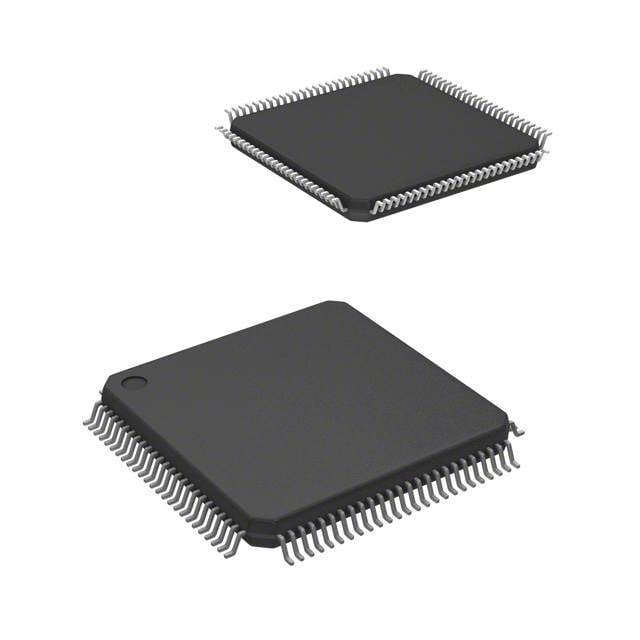
The STMicroelectronics STM32F407VET6 is a high-performance microcontroller that is part of the STM32 F4 series, based on the ARM Cortex-M4 processor. It is designed for a wide range of applications, offering excellent performance, rich peripheral integration, and low power consumption. This microcontroller is widely used in embedded systems, industrial automation, robotics, consumer electronics, and IoT devices due to its flexible and powerful features. Below is a comprehensive overview of the STM32F407VET6, including its specifications, features, and key advantages.
## Overview
The STM32F407VET6 is a 32-bit microcontroller built around the ARM Cortex-M4 core, which provides significant computational power while maintaining energy efficiency. This MCU runs at up to 168 MHz, offering high performance for real-time applications. It is equipped with a wide range of peripherals and interfaces, making it versatile for various embedded applications that require high-speed processing and connectivity.
The STM32F407VET6 is suitable for applications requiring complex control, real-time signal processing, data handling, and interfacing with a wide variety of peripherals. It is particularly well-suited for real-time embedded systems, motor control, communications, and audio applications.
## Key Specifications
- Core Architecture: ARM Cortex-M4 with Floating-Point Unit (FPU)
- Core Speed: 168 MHz
- Flash Memory: 512 KB (program storage)
- SRAM: 192 KB (data storage)
- Operating Voltage: 2.0V to 3.6V
- Package Type: LQFP-100 (100 pins)
- Temperature Range: Industrial (-40°C to 85°C)
- Timers: 14 timers (including advanced control timers)
- DMA Channels: 16 Direct Memory Access (DMA) channels
- Watchdog Timers: Independent Watchdog (IWDG) and Window Watchdog (WWDG)
- General Purpose I/O (GPIO) Pins: 82
- Data Bus Width: 32-bit
- Interrupts: 82 interrupt vectors
- Communication Interfaces:
- 2x SPI
- 3x I2C
- 2x UART/USART
- CAN
- USB 2.0 Full-Speed Device/Host/OTG
- Ethernet MAC (for network connectivity)
- SDIO (for SD card interfaces)
- Analog Interfaces:
- 12-bit, 16-channel ADC (Analog-to-Digital Converter)
- 12-bit DAC (Digital-to-Analog Converter)
## Performance Features
1. ARM Cortex-M4 Processor:
- The STM32F407VET6 is powered by the ARM Cortex-M4 core, which includes a Floating-Point Unit (FPU). The core can run at speeds up to 168 MHz, which provides excellent computational capabilities, especially for digital signal processing (DSP) applications and other math-intensive tasks. The FPU improves the performance of tasks that require floating-point calculations, such as signal processing, control algorithms, and communications.
2. High-Speed Memory:
- The STM32F407VET6 is equipped with 512 KB of Flash memory for program storage, enabling the device to handle large codebases and execute sophisticated applications. In addition, it has 192 KB of SRAM for data storage, which is sufficient for handling multiple tasks, buffers, and stack requirements in real-time systems.
3. Timers and Real-Time Control:
- The microcontroller includes 14 timers, including:
- General-purpose timers for basic time-counting tasks.
- Advanced control timers, which are essential for applications like motor control and PWM (pulse-width modulation) generation.
- Basic timers for watchdog timer functions or simple delay generation.
These timers are critical in systems requiring real-time control, such as in industrial automation or robotics.
4. Analog Interfaces:
- The STM32F407VET6 provides a 12-bit ADC with 16 channels for high-resolution analog-to-digital conversion. This ADC can handle sample rates of up to 2 MSPS (million samples per second), making it suitable for applications such as sensor data acquisition, audio processing, and signal analysis.
- Additionally, it has two 12-bit DACs, which can generate analog output signals for applications like waveform generation, audio output, and other control systems.
5. Direct Memory Access (DMA):
- The microcontroller supports 16 DMA channels, which allows efficient data transfers between memory and peripherals without involving the CPU. This significantly reduces CPU load, enhancing overall system performance, especially in data-intensive applications like video, audio streaming, or sensor data acquisition.
6. Watchdog Timers:
- The Independent Watchdog (IWDG) and Window Watchdog (WWDG) are included to ensure that the system remains operational in case of unexpected faults or malfunctions. These watchdog timers are particularly important for real-time and safety-critical applications, where system failure must be detected and corrected quickly.
7. Low Power Modes:
- Despite its high performance, the STM32F407VET6 offers several low-power modes, including Sleep, Stop, and Standby modes, to conserve energy in battery-operated or energy-sensitive systems. These modes allow the microcontroller to maintain its state while reducing its power consumption when the system is idle.
## Communication Interfaces
1. USB 2.0 Full-Speed:
- The STM32F407VET6 includes USB 2.0 support, allowing it to function as a host, device, or OTG (On-The-Go) device. This enables it to interface with a wide range of USB peripherals and communicate with other systems over USB.
2. Ethernet MAC:
- The Ethernet MAC allows the STM32F407VET6 to connect directly to Ethernet networks. This feature is essential for IoT devices, industrial controllers, and other applications requiring network connectivity for remote communication, data exchange, and device monitoring.
3. Multiple Serial Communication Options:
- The microcontroller supports several serial communication protocols, including UART/USART, SPI, I2C, and CAN, which are useful for communicating with sensors, actuators, displays, and other embedded devices. The rich set of communication interfaces makes the STM32F407VET6 ideal for systems requiring complex communication or multi-protocol support.
4. SDIO Interface:
- The SDIO interface allows the microcontroller to interface with SD cards or other external memory devices. This is useful for applications that require large data storage or file handling, such as logging systems, data acquisition, and multimedia applications.
## Software and Development Tools
The STM32F407VET6 is supported by a robust set of development tools, both from STMicroelectronics and third-party vendors:
1. STM32CubeMX:
- STM32CubeMX is a graphical tool that helps developers configure the microcontroller, set up the peripherals, and initialize the clock system. It simplifies the process of setting up hardware configurations for STM32-based projects.
2. STM32CubeIDE:
- STM32CubeIDE is an integrated development environment (IDE) that supports C/C++ development for STM32 microcontrollers. It includes features for project creation, debugging, and managing the development lifecycle.
3. HAL (Hardware Abstraction Layer) and LL Drivers:
- STM32Cube provides both HAL (Hardware Abstraction Layer) and Low-Level Drivers (LL), which simplify the development process by providing APIs for peripheral management and control. Developers can choose between the high-level HAL for easier software development or the low-level LL drivers for more fine-grained control.
4. RTOS Support:
- The STM32F407VET6 is compatible with real-time operating systems (RTOS) like FreeRTOS, which is useful for complex applications requiring multitasking, real-time scheduling, and inter-process communication.
## Applications
The STM32F407VET6 is designed for a broad range of embedded applications, including but not limited to:
- Industrial Automation: It is used for controlling motors, sensors, and actuators, as well as for data acquisition and real-time monitoring in industrial environments.
- Robotics: The microcontroller is ideal for robotics systems that require motor control, sensor integration, and real-time processing.
- Consumer Electronics: It powers various consumer products, such as audio systems, home automation devices, and wearable technology.
- IoT (Internet of Things): With its network connectivity options (Ethernet, USB), the STM32F407VET6 is well-suited for IoT devices, such as smart sensors, connected appliances, and monitoring systems.
- Automotive Systems: The microcontroller is used in automotive applications for controlling systems such as sensors, lighting, and communication between embedded devices in vehicles.
## Conclusion
The STM32F407VET6 is a powerful, versatile microcontroller that offers a robust set of features for demanding embedded applications. With its ARM Cortex-M4 core, high-speed memory, rich peripheral set, and low-power features, it is ideal for applications ranging from industrial control to consumer electronics and IoT devices. The strong software support and extensive development tools provided by STMicroelectronics make the STM32F407VET6 a reliable choice for developers working on complex, real-time, and networked systems.