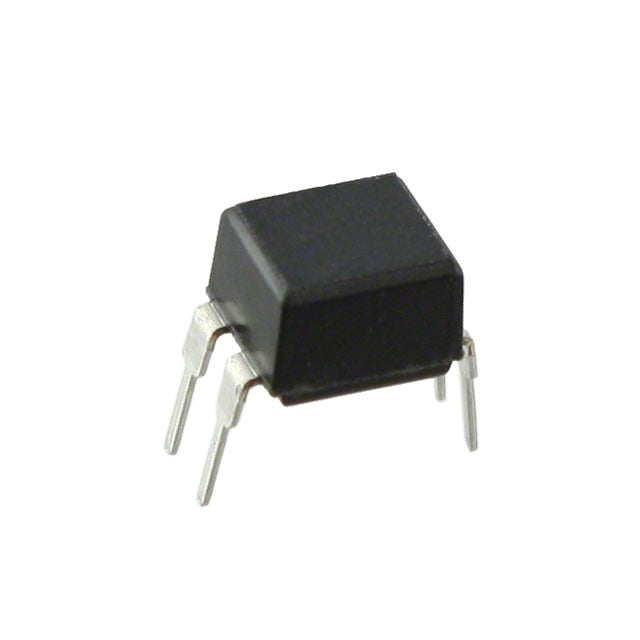
Q1: What is the primary function of the Sharp Microelectronics PC123?
A1: The Sharp Microelectronics PC123 is an optocoupler designed for signal isolation between circuits. It uses an LED to transmit signals across an optically coupled phototransistor for electrical isolation.
Q2: What is the input voltage range for the Sharp Microelectronics PC123?
A2: The Sharp Microelectronics PC123 operates with an input voltage range of 1.2V to 5V, making it suitable for low-voltage logic circuits.
Q3: What is the output current for the Sharp Microelectronics PC123?
A3: The PC123 provides a maximum output current of 50mA, which is ideal for driving loads such as microcontrollers or other logic devices.
Q4: What is the operating temperature range of the PC123?
A4: The operating temperature range for the Sharp Microelectronics PC123 is from -30°C to +100°C, allowing it to be used in a variety of environmental conditions.
Q5: What type of package is the PC123 available in?
A5: The Sharp Microelectronics PC123 comes in a compact 4-pin DIP (Dual In-line Package) for easy integration into circuit boards.
Q6: What is the isolation voltage of the PC123?
A6: The isolation voltage of the Sharp Microelectronics PC123 is 5kV, providing high levels of electrical isolation between input and output.
Q7: How does the PC123 handle signal transmission?
A7: The PC123 uses an LED to transmit light signals to a phototransistor, which then converts the light back into an electrical signal, ensuring high-speed signal transmission with isolation.
Q8: What is the forward voltage of the LED in the PC123?
A8: The forward voltage of the LED in the Sharp Microelectronics PC123 is typically 1.2V, allowing it to operate efficiently with low power consumption.
Q9: What is the gain of the phototransistor in the PC123?
A9: The phototransistor in the Sharp Microelectronics PC123 has a current transfer ratio (CTR) ranging from 50% to 600%, depending on the specific operating conditions.
Q10: Can the PC123 be used for both low and high-frequency applications?
A10: Yes, the PC123 is capable of handling both low and high-frequency applications, making it versatile for use in a wide range of signal isolation tasks.
Q11: Does the PC123 have any protection features?
A11: The Sharp Microelectronics PC123 includes built-in protection against input overcurrent and short circuits, ensuring reliable performance in various circuit designs.
Q12: What is the typical response time of the PC123?
A12: The Sharp Microelectronics PC123 has a typical response time of 50μs, ensuring fast signal transmission with minimal delay.
Q13: What is the maximum output voltage of the PC123?
A13: The maximum output voltage of the PC123 is 35V, making it suitable for use in a wide variety of voltage environments.
Q14: How does the PC123 maintain signal integrity?
A14: The PC123 ensures signal integrity by providing optical isolation, preventing noise and voltage spikes from affecting the signal transmission.
Q15: Is the PC123 compatible with 5V logic circuits?
A15: Yes, the Sharp Microelectronics PC123 is fully compatible with 5V logic circuits, making it ideal for use in modern digital systems.
Q16: What is the switching speed of the PC123?
A16: The PC123 has a switching speed of up to 10MHz, allowing it to function effectively in high-speed communication systems.
Q17: Can the PC123 be used for DC and AC signal isolation?
A17: Yes, the Sharp Microelectronics PC123 is designed to handle both DC and AC signals, making it a versatile choice for various signal isolation needs.
Q18: What is the current consumption of the PC123?
A18: The current consumption of the Sharp Microelectronics PC123 is typically low, with a forward current of about 10mA, making it energy-efficient in low-power applications.
Q19: What are the main applications of the PC123?
A19: The PC123 is commonly used in applications such as data transmission, microcontroller isolation, industrial control systems, and motor drivers, where signal isolation is crucial.
Q20: Is the PC123 RoHS compliant?
A20: Yes, the Sharp Microelectronics PC123 is RoHS compliant, meaning it is free from hazardous substances such as lead, ensuring it meets environmental standards.