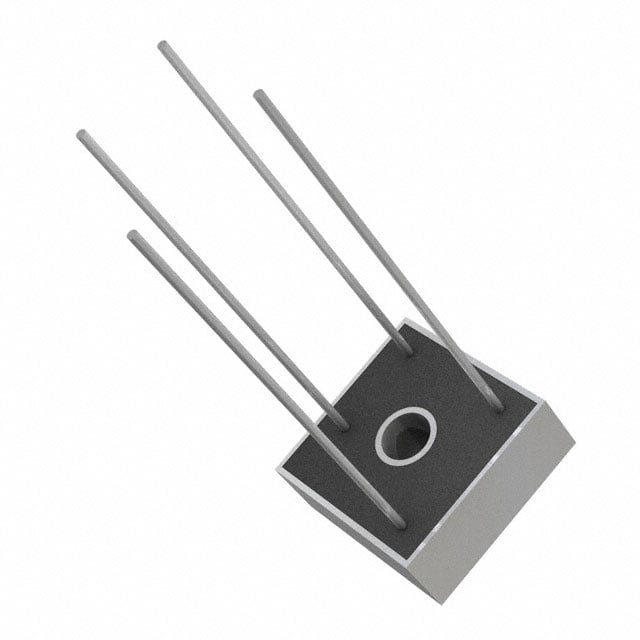
When it comes to AC-to-DC conversion, bridge rectifiers are commonly used due to their simplicity and effectiveness. However, there are alternative methods for achieving this conversion. Let%27s explore a few of them:
1. Half-Wave Rectifiers:
- While not as efficient as bridge rectifiers, half-wave rectifiers can convert AC to DC using only two diodes.
- They rectify only one half of the AC waveform, resulting in higher ripple and lower efficiency.
- Half-wave rectifiers are suitable for low-power applications where cost and simplicity are more critical than efficiency³.
2. Center-Tapped Full-Wave Rectifiers:
- These rectifiers use a center-tapped transformer along with two diodes.
- They provide full-wave rectification by utilizing both halves of the AC waveform.
- Center-tapped rectifiers are commonly used in low-power applications where a center-tapped transformer is available³.
3. Voltage Multipliers:
- Voltage multipliers, such as the Cockcroft-Walton circuit, can step up the output voltage.
- They use a combination of diodes and capacitors to achieve higher DC voltages.
- Voltage multipliers are often used in high-voltage applications, such as X-ray machines and particle accelerators⁴.
4. Switching Power Supplies (SMPS):
- Switching power supplies, also known as SMPS, use high-frequency switching to convert AC to DC.
- They are more complex but highly efficient.
- SMPS are widely used in electronic devices, computers, and power adapters⁴.
5. Voltage Regulators:
- While not direct AC-to-DC converters, voltage regulators can stabilize and regulate DC output voltage.
- Linear voltage regulators (such as LM7805) are simple and commonly used for low-power applications.
- Switching voltage regulators (such as buck or boost converters) are more efficient but more complex⁴.
6. Inverters:
- Inverters convert DC power into AC power.
- While not the same as rectifiers, they serve the purpose of changing the power source.
- Inverters are essential for solar panels, uninterruptible power supplies (UPS), and motor drives².
In summary, while bridge rectifiers remain a popular choice for AC-to-DC conversion, these alternatives offer different trade-offs in terms of efficiency, complexity, and cost. The choice depends on the specific application requirements and constraints³⁴.
(1) What is AC to DC Converters and Different Types of Converters. https://www.electricalpowerenergy.com/2017/04/ac-to-dc-converters/.
(2) Diode Bridge: Four Diodes That Convert From AC to DC. https://www.build-electronic-circuits.com/diode-bridge-rectifier/.
(3) Can A Bridge Rectifier Convert DC To AC? - The Bridal Tip. https://thebridaltip.com/can-a-bridge-rectifier-convert-dc-to-ac/.
(4) Bridge Rectifier Calculator. https://www.omnicalculator.com/physics/bridge-rectifier.
icDirectory Limited | https://www.icdirectory.com/a/blog/are-there-any-alternatives-to-bridge-rectifiers-for-ac-to-dc-conversion.html

☰