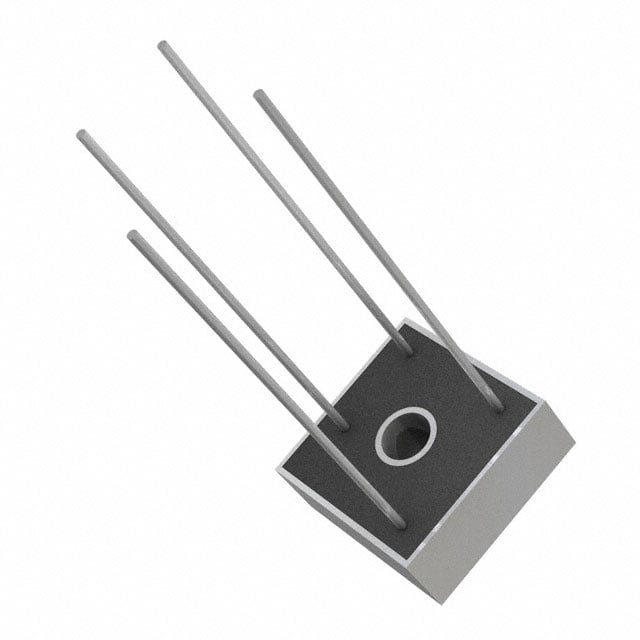
Selecting an appropriate heat sink for a bridge rectifier involves several considerations to ensure efficient operation and prevent overheating. Let%27s delve into the details:
1. Bridge Rectifier Basics:
- A bridge rectifier converts alternating current (AC) to direct current (DC). It consists of four diodes arranged in a bridge configuration.
- During the positive half-cycle of the input voltage, two diodes conduct, allowing current flow. In the negative half-cycle, the other two diodes conduct.
- The output voltage is obtained due to the forward-biased diodes in each cycle.
2. Why Use a Heat Sink?:
- Bridge rectifiers dissipate heat during operation. Excessive heat can degrade performance and reduce reliability.
- A heat sink provides a path for heat dissipation, preventing the rectifier from reaching critical temperatures.
3. Selecting the Right Heat Sink:
- Consider the following factors:
- Power Dissipation: Calculate the power dissipation in the bridge rectifier. This depends on the load current and voltage drop across the diodes.
- Thermal Resistance: Heat sinks have a thermal resistance (°C/W) indicating how effectively they transfer heat. Lower values are better.
- Ambient Temperature: Consider the environment where the rectifier operates. Hotter environments require more efficient heat sinks.
- Mounting Space: Ensure the heat sink fits within the available space.
- Heat Sink Material: Aluminum is commonly used due to its good thermal conductivity.
- Fin Design: Larger fins increase surface area for better heat dissipation.
- Orientation: Mount the heat sink vertically or horizontally based on available space and airflow.
4. Installation Tips:
- Orientation: Typically, mount the heat sink with the text side up (where lead markings like "+" and "-" are visible).
- Thermal Path: Ensure a minimum thickness of plastic between the lead frame and the heat sink.
- Original Datasheets: When dealing with second-sourced products, refer to the original datasheets for additional information.
Remember that proper heat sink selection ensures reliable and efficient operation of your bridge rectifier. ️<br>
For more detailed information, you can explore resources like ⁵ and ⁶.
(1) How2Power.com - How To Select Bridge Rectifiers. http://www.how2power.com/article/2019/october/how-to-select-bridge-rectifiers.php.
(2) Cooling of bridge rectifier | diyAudio. https://www.diyaudio.com/community/threads/cooling-of-bridge-rectifier.275808/.
(3) #9 working of Bridge rectifier || EC Academy. https://www.youtube.com/watch?v=34hWklTgzbI.
(4) Installing the Bridge Rectifier & Heatsink - Harbor Freight Gasless Flux Core Welder Mods (Part 3). https://www.youtube.com/watch?v=IeggagtzVMo.
(5) How a Bridge Rectifier works - Step by step Tutorial - DERF Electronics. https://www.youtube.com/watch?v=j5p7TIn-5fY.
(6) Installing heatsink on a bridge rectifier: which side of the rectifier .... https://electronics.stackexchange.com/questions/585695/installing-heatsink-on-a-bridge-rectifier-which-side-of-the-rectifier-should-it.
(7) Selecting the Right Heat Sink for your Design - Components101. https://components101.com/articles/selecting-the-right-heatsink-for-your-design-and-steps-for-heatsink-calculation-and-selection.
(8) undefined. https://www.youtube.com/channel/UClm4AsU5w3_509rlTMaGXbw?sub_confirmation=1.
icDirectory Limited | https://www.icdirectory.com/a/blog/how-do-you-select-the-appropriate-heat-sink-for-a-bridge-rectifier.html

☰