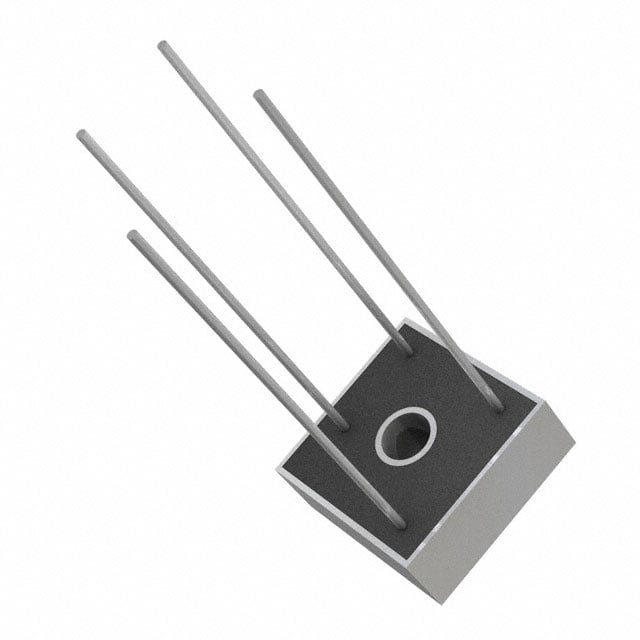
When designing bridge rectifiers, several critical considerations ensure their optimal performance. Let%27s explore these in detail:
1. Voltage and Current Ratings:
- Select diodes with appropriate voltage and current ratings.
- The voltage rating should exceed the maximum AC input voltage.
- Ensure that the diodes can handle the expected load current without overheating.
2. Reverse Recovery Time (t_rr):
- Choose diodes with fast recovery times to minimize switching losses.
- Longer t_rr leads to increased power dissipation and voltage spikes.
- Ultrafast diodes are ideal for high-frequency applications.
3. Thermal Considerations:
- Diodes dissipate heat during operation.
- Use heat sinks or ensure adequate PCB copper area for heat dissipation.
- Monitor junction temperature to prevent thermal breakdown.
4. PCB Layout Design:
- Keep diodes close together to minimize inductance.
- Shorten traces to reduce resistance and voltage drops.
- Place the filter capacitor near the diodes for efficient smoothing.
5. Filter Capacitor Selection:
- Choose a capacitor with sufficient capacitance to reduce ripple voltage.
- Consider the ESR (Equivalent Series Resistance) of the capacitor.
6. Noise and Interference:
- Proper grounding and shielding minimize noise.
- Use low-ESR capacitors to suppress high-frequency noise.
7. Voltage Spikes and Snubber Circuits:
- Voltage spikes during diode switching can damage components.
- Add snubber circuits (RC networks) to dampen voltage spikes.
8. Isolation and Safety:
- Ensure proper isolation between AC and DC sides.
- Use creepage and clearance distances on the PCB.
- Consider safety standards (e.g., UL, IEC).
9. Component Placement:
- Arrange components logically for ease of assembly and testing.
- Follow best practices for component orientation.
10. Testing and Verification:
- Verify the rectifier%27s performance using simulations or prototypes.
- Measure output voltage, ripple, and efficiency.
In summary, bridge rectifier design involves balancing electrical, thermal, and layout considerations to achieve reliable and efficient AC-to-DC conversion. ️<br>
(1) Bridge Rectifier PCB Design: Tips and Best Practices. https://hillmancurtis.com/bridge-rectifier-pcb-design/.
(2) A Guide to Bridge Rectifiers - dech.rs-online.com. https://dech.rs-online.com/web/content/discovery/ideas-and-advice/bridge-rectifiers-guide.
(3) Bridge Rectifiers: What is it? (Circuit Diagram ... - Electrical4U. https://www.electrical4u.com/bridge-rectifiers/.
(4) Bridge Rectifier – Construction, Working, Characteristics and Types. https://www.geeksforgeeks.org/bridge-rectifier/.
icDirectory Limited | https://www.icdirectory.com/a/blog/what-are-the-key-design-considerations-for-bridge-rectifiers.html

☰