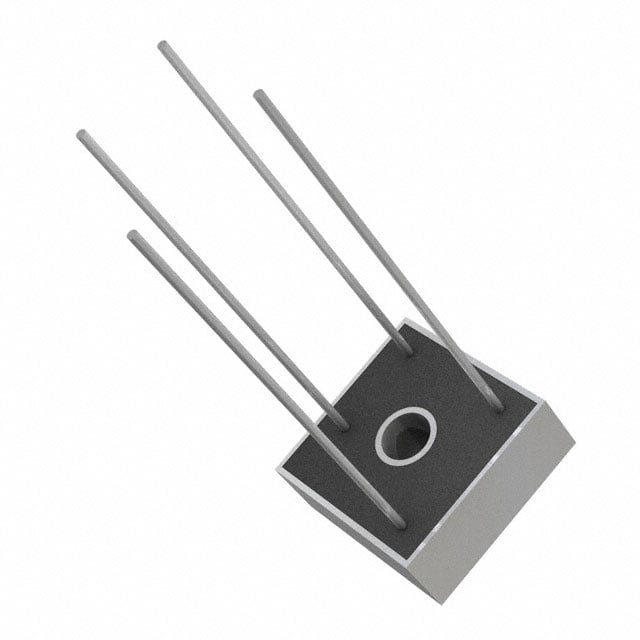
Let%27s delve into the trade-offs between efficiency and voltage drop in bridge rectifiers:
1. Efficiency:
- Efficiency refers to how effectively a bridge rectifier converts alternating current (AC) voltage into direct current (DC) voltage.
- Higher efficiency means less energy loss during the conversion process.
- Bridge rectifiers are generally more efficient than half-wave rectifiers due to their ability to utilize both halves of the AC waveform.
2. Voltage Drop:
- The voltage drop across diodes is a critical factor in bridge rectifiers.
- During each half-cycle of the AC input, two diodes conduct current.
- The voltage drop across these conducting diodes affects the overall efficiency.
- The voltage drop is typically around 0.7 V for silicon diodes.
3. Trade-offs:
- Efficiency vs. Voltage Drop:
- As the voltage drop across diodes decreases, efficiency improves.
- However, achieving extremely low voltage drops may require using specialized diodes (e.g., Schottky diodes), which can be costlier.
- Balancing Efficiency and Cost:
- High-efficiency diodes reduce power loss but may come at a higher price.
- Engineers must strike a balance between efficiency gains and component costs.
4. Practical Considerations:
- Heat Dissipation: Lower voltage drops result in less heat dissipation.
- Component Selection: Choose diodes with an optimal balance of voltage drop and cost.
- Application Requirements: Consider whether the application demands maximum efficiency or cost-effectiveness.
5. Real-World Example:
- Bridge rectifiers often use standard silicon diodes with a typical voltage drop of 0.7 V.
- While this voltage drop affects efficiency, it remains acceptable for most applications.
In summary, bridge rectifiers achieve a balance between efficiency and voltage drop. Engineers must select diodes based on cost, efficiency requirements, and practical considerations to optimize performance. ️<br>[Learn more](^13^) about bridge rectifiers and their characteristics.
(1) Bridge Rectifier - Definition, Factor, Efficiency and Advantages - Vedantu. https://www.vedantu.com/physics/bridge-rectifier.
(2) Bridge Rectifier – Construction, Working, Characteristics and Types. https://www.geeksforgeeks.org/bridge-rectifier/.
(3) What is a bridge rectifier? - Electricity - Magnetism. https://www.electricity-magnetism.org/what-is-a-bridge-rectifier/.
(4) Bridge Rectifiers: What is it? (Circuit Diagram ... - Electrical4U. https://www.electrical4u.com/bridge-rectifiers/.
(5) Bridge Rectifiers | How it works, Application & Advantages - Magnetism. https://www.electricity-magnetism.org/bridge-rectifiers/.
(6) Bridge Rectifier | How it works, Application & Advantages - Magnetism. https://www.electricity-magnetism.org/bridge-rectifier/.
(7) Full Bridge Rectifier - Voltage Drop Under Load. https://electronics.stackexchange.com/questions/465072/full-bridge-rectifier-voltage-drop-under-load.
(8) Bridge rectifier equation | Example of Calculation. https://www.electricity-magnetism.org/bridge-rectifier-equation/.
(9) Full Bridge Rectifier Explained - The Engineering Mindset. https://theengineeringmindset.com/full-bridge-rectifier-explained/.
(10) capacitor - How to calculate voltage after rectifier? - Electrical .... https://electronics.stackexchange.com/questions/250887/how-to-calculate-voltage-after-rectifier.
(11) How to Troubleshoot a Diode Bridge Rectifier - Technical Articles. https://www.allaboutcircuits.com/technical-articles/troubleshooting-a-diode-bridge-rectifier/.
(12) Bridge Rectifier - Electronics Reference. https://electronicsreference.com/analog/bridge_rectifier/.
(13) Learn and Master Testing a Bridge Rectifier for Optimum Performance. https://electric-shocks.com/testing-a-bridge-rectifier/.
(14) AC Rectifier Efficiency - Bright Hub Engineering. https://www.brighthubengineering.com/consumer-appliances-electronics/96645-efficiency-of-ac-rectifiers/.
icDirectory Limited | https://www.icdirectory.com/a/blog/what-are-the-trade-offs-between-efficiency-and-voltage-drop-in-bridge-rectifiers.html

☰